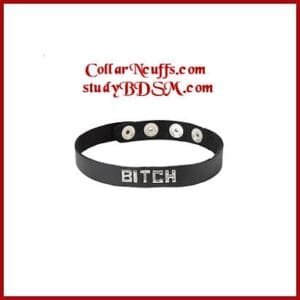
Collar Blindness describes a mindset where someone is willing to do anything to attain a collar, without taking the time to self‑reflect or fully understand the responsibilities inherent in being collared. In Femdom, experienced Dommes encounter this far too often.
A collar is an earned symbol of commitment and devotion within a Femdom relationship. It is highly revered in the community—much like marriage in the vanilla world. For clarity, this discussion does not refer to play collars or training collars.
Before social media became a stage for displaying status, people often flashed wedding rings to signal they were “taken,” implying they were further along in life or had achieved a higher social status. For many entering kink spaces today, being collared has become an equivalent symbol—something to be pursued, displayed, and admired.
The problem arises when the symbol becomes more important than the relationship it is meant to represent.
Reach For Your Dreams
Whether you’re looking to enhance your relationship or simply explore your own desires, our Community provides a safe and supportive space for you to thrive. So come and join us today, and embrace a world of exciting possibilities.
What Is Collar Blindness, Really?
Collar Blindness occurs when someone pursues a collar blindly—because they have absorbed an idea of what they should want—without fully examining what that commitment entails or whether it truly aligns with their values, needs, and capacity.
Instead of viewing the collar as a reflection of a healthy, functioning relationship, it becomes the goal itself. The person buys into an imagined outcome without evaluating the process, the sacrifices, or the long‑term reality.
What Causes Collar Blindness?
People susceptible to Collar Blindness often live by unexamined “shoulds.” They may lack self‑awareness and feel compelled to meet perceived expectations rather than act from genuine desire. These are individuals who do things because they believe that is what one does next.
A relatable parallel is early-stage romantic infatuation—sometimes called participation mystique. During this phase, adrenaline and novelty can override discernment. Red flags are minimized, differences ignored, and the relationship is idealized. Biologically speaking, this state exists to encourage bonding, not clear-eyed evaluation.
A similar mechanism appears in strict religious or ideological upbringings. When someone is raised with rigid belief systems, they often develop blinders. They see themselves as “of” the group, rather than “part” of the group. Individuation, maturity, and self-definition are delayed until boundaries are encountered and challenged.
For example, when religious doctrine conflicts with natural desire—such as sexuality—the resulting internal conflict can force a person to confront their individuality for the first time.
In Femdom, Collar Blindness can shatter when the person finally thinks:
“Maybe I don’t want to place my loyalty here.”
This realization can trigger an existential crisis—not unlike a midlife crisis—where meaning collapses and questions arise: What was all of this for? Was I chasing a distraction?
The Vanilla Parallel: Chasing the Ring
In vanilla life, many divorced women never want to marry again—not because marriage itself is inherently flawed, but because they disliked who they became within it. Often, the marriage was entered for the ring, the wedding, or the milestone, rather than from informed, self-aware commitment.
This doesn’t mean those choices were foolish. It means the person did not yet know themselves well enough to ask, Is this right for me? Instead, marriage was assumed to be a default life goal.
Marriage—like collaring—is an arbitrary structure. So are traditional gender roles. None of these frameworks are inherently wrong. What matters is whether the structure serves the people inside it.
Green Flags Before a Collar
Before a collar is even considered, healthy dynamics usually show these signs:
- Open, two-way communication where concerns can be voiced without fear.
- Clear expectations discussed in advance—roles, limits, time, and power.
- Consistency between words and actions over time.
- Mutual benefit: both partners feel fulfilled, supported, and seen.
- The relationship already functions well without a collar.
- The collar feels like a natural progression, not a solution or reward.
If these green flags are missing, a collar will not create them.
Who Is Most Prone to Collar Blindness?
Certain patterns appear consistently:
Underdeveloped maturity. This is universal at some stage of life. Anyone who has felt their worth defined by a group—and later felt betrayed by that group—has experienced this. It also commonly happens after first loves or first serious power dynamics.
Habitual assimilators. These individuals absorb rhetoric from social media, kink spaces, or peer groups without critically examining it. They repeat ideas without integrating them. Independent thinking is underdeveloped.
Belief in rigid “shoulds.” The unifying trait is the belief that life follows a prescribed checklist. These individuals don’t yet know themselves well enough to reject expectations that don’t fit.
This mindset is common among younger people and deeply embedded in older generations. While traditional frameworks offer stability—and society has benefited from that—they are not universally fulfilling.
🔎 Sidebar: Collar ≠ Validation
A collar is not proof of worth, desirability, or success in Femdom.
Being collared does not mean you are more evolved, more submissive, or more legitimate than someone who is not. It does not fix insecurity, fast-track intimacy, or substitute for self-knowledge.
If the desire for a collar is rooted in wanting to feel chosen, special, or complete, that need will not disappear once the collar is placed. In many cases, it intensifies—because the symbol cannot do the emotional work it is being asked to perform.
Validation comes from self-awareness, boundaries, and mutual alignment—not from symbols worn on the body.
How to Recognize, Stop, and Prevent Collar Blindness
Before pursuing a collar, ask yourself—honestly—the following:
- Do I know what it truly takes to be collared?
- What does being collared actually mean in practice?
- Am I willing and able to meet those expectations long term?
- What do I gain from this commitment?
- Do I understand that contributing to something that does not benefit me is taking a bad deal?
- Do I genuinely want this, or do I think I should want this?
If you cannot answer every one of these questions clearly and thoroughly, you do not yet have the awareness required to avoid regret.
You may be tempted to think, “If I didn’t know better, I can’t regret it.”
Nope.
That excuse doesn’t protect you.
Faith matters. People do not invest effort into things they do not believe in. If you do not know where your faith is placed, the eventual awakening will be painful.
A Final Reality Check
If you are in a relationship that is not working for you—do not get collared.
There is a profound difference between being collared in a relationship that can work and one that won’t. Relationships that can work may require effort, but they do not feel like constant resistance.
If it feels like pulling teeth, someone lacks faith in the relationship.
[Side‑eyes your partner.]
A collar should reflect devotion already present—not compensate for what is missing.